ProVisu. Trustworthy Internet documents on vision disorders, eye diseases and the prevention of blindness. Home
<< Back
   Click here to disabled the audio version
All diseases: [Alt+ A B C D E F G H I J K L M N O P Q R S T U V W X Y Z ]

Thyroid-associated ophthalmopathy

Generality/Definition
  • Listen / Stop:
    The majority of patients with eye disease will present with both hyperthyroidism and the eye disease simultaneously.
    The eye involvement :
  • may precede or follow the development of hyperthyroidism
  • may be present alone, without evidence for thyroid dysfunction.

  • Thyroid ophthalmopathy, also known as Graves' eye disease, often coexists with autoimmune thyroid diseases such as Graves' disease or less commonly, Hashimoto's thyroiditis.
    Source: MyThyroid.com: Eye Disease (mythyroid.com)
       Other information: Open - Close

Epidemiology

  • Listen / Stop:
  • Various studies suggest that Thyroid-Associated orbitopathy affects women 2.5-6 times more frequently than men.
  • Thyroid-Associated orbitopathy mostly affects persons aged 30-50 years.
  • Many patients with Thyroid-Associated orbitopathy are hyperthyroid, but the following conditions also are associated with Thyroid-Associated orbitopathy: euthyroidism (20%), Hashimoto thyroiditis, thyroid carcinoma, and neck irradiation.
  • Radioactive iodine and thyroid ophthalmopathy Several publications have suggested that thyroid ablation with orally ingested radioactive iodine (RAI; I-131) may exacerbate Thyroid-Associated orbitopathy compared to antithyroid drugs or surgical ablation.

  • Source: eMedicine - Thyroid Ophthalmopathy : Article by Edsel Ing, MD, FRCS(C) (emedicine.com)
       Other information: Open - Close

Prevention

  • Listen / Stop:
  • Encourage patients to stop smoking to decrease the risk of congestive orbitopathy.
  • To prevent progression of thyroid-associated orbitopathy from radioactive iodine, pretreatment and posttreatment with low-dose steroids has been suggested for as long as 2 months after treatment (if the patient has no contraindications for steroids and agrees to this treatment).
  • Several studies have not shown that radioiodine is a significant risk for initiation or progression of mild Thyroid-Associated orbitopathy.

  • Source: eMedicine - Thyroid Ophthalmopathy : Article by Edsel Ing, MD, FRCS(C) (emedicine.com)
       Other information: Open - Close

Symptoms

  • Listen / Stop:
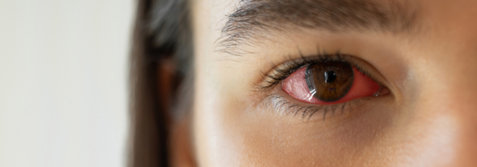
  • Redness and irritation in the eyes is common.
  • Double vision, Eye dryness, Excessive tearing
  • Exophthalmos, proptosis (protrusion of the eyes)
  • Increased intraocular pressure ( risk for glaucoma)
  • Irritation, Light sensitivity, Swelling of the eyelids
  • Upper and lower eyelid retraction. Patients may have difficulty closing their eyes completely, which can lead to irritation, dryness, and corneal abrasions.
  • Compress the optic nerve.
  • In rare instances: Optic neuropathy and possibly vision loss.

  • Source: Graves' Opthalmopathy - VisionChannel (visionchannel.net)

Diagnosis

  • Listen / Stop:
  • Based on clinical signs and symptoms
  • thyroid function test.
  • A CT scan or ultrasound is performed to determine if the muscles around the eye are swollen and to detect fibrosis (hardening of muscle tissue).
  • The specialist measures how far the eye protrudes with an exophthalmometer.

  • Source: Graves' Opthalmopathy - VisionChannel (visionchannel.net)
       Other information: Open - Close

Treatment

  • Listen / Stop:
    Medical Care:
  • Inform patients that Thyroid-Associated orbitopathy usually runs a self-limited but prolonged course over one or more years. They also should realize that no immediate cure is available.
  • If a patient has dry eye symptoms, consider using artificial tears during the day, lubricating ointment at night, and punctal plugs. Sleeping with the head of the bed elevated may decrease morning lid edema. Tape occlusion of one lens or segment of the glasses may be helpful.
  • Oral steroids usually are reserved for patients with severe inflammation or compressive optic neuropathy.
  • Octreotide, a potent synthetic somatostatin analogue, has a beneficial effect in Thyroid-Associated orbitopathy, especially in patients with a positive Octreoscan-111.
  • Radiation requires several weeks to take effect, and it may transiently cause increased inflammation. Better response to radiation is seen in patients who are treated within 7 months of Thyroid-Associated orbitopathy onset.
  • Compressive optic neuropathy : If necessary, high-dose steroids and higher intravenous doses are given. If no response occurs after 24 hours, steroids probably will not work; at this point, the patient should get surgical decompression and maintain steroids.
  • Surgical Care (5% of patients may require surgical intervention):
  • The patient should know that multiple-staged procedures may be required. Unless compressive optic neuropathy or severe corneal exposure occur, surgery generally is delayed during the active inflammatory phase of Thyroid-Associated orbitopathy.
  • Patients should realize that the goal of surgery is to minimize diplopia in the primary and reading positions. Expecting binocular single vision in all positions of gaze may not be reasonable. Patients also should realize that multiple strabismus surgeries and prisms may be required.
  • Lid-lengthening surgery If restoration of the euthyroid state does not improve lid retraction, consider lid-lengthening surgery.
  • Blepharoplasty This is the last phase of restorative surgery in Thyroid-Associated orbitopathy.
    Source: eMedicine - Thyroid Ophthalmopathy : Article by Edsel Ing, MD, FRCS(C) (emedicine.com)

Illustrations

Source: eMedicine - Thyroid Ophthalmopathy : Article by Edsel Ing, MD, FRCS(C) (emedicine.com)


Exophtalmos

Source: LearningRadiology.com -Thyroid Ophthalmopathy, Grave's Disease, eye, (learningradiology.com)


Axial and coronal CT scans of the orbits show marked enlargement of the extraocular muscles with sparing of the tendons consistent with the ophthalmopathy seen with Grave's disease.

Information for specialists

  • Listen / Stop:
    Protrusion of the eyes of patients with autoimmune thyroid disease was compared with that of healthy subjects. The mean values for protrusion in patients with thyrotoxic Graves' disease and Hashimoto's disease and in healthy subjects were 16.6 +/- 2.1 mm (mean +/- SD; n = 122), 14.2 +/- 1.8 mm (n = 100), and 13.9 +/- 1.9 mm (n = 558), respectively. The value of Graves' disease was significantly different from that for healthy subjects (P < 0.001). Individual values for protrusion showed a similar normal distribution in these three groups, but were displaced to higher values as a whole in Graves' disease. These results, which suggest that almost all patients with Graves' disease have exophthalmos, do not support the idea that Graves' ophthalmopathy is a distinct single autoimmune disease.
    Source: Exophthalmos in autoimmune thyroid disease -- Amino et al. 51 (6): 1232 -- Journal of Clinical Endocrinology & Metabolism (jcem.endojournals.org)
       Other information: Open - Close

Association

       Other information: Open - Close        Other information: Open - Close        Other information: Open - Close

Scientific articles: All recent articles for "Exophthalmos"

Clinical trials for "Exophthalmos":

Search Web pages:
[ Cette page en français ] [ Esta página en español ]
What do you think of this site
Vocalization by ReadSpeaker
Last modified: Feb 2007
This website is accredited by Health On the Net Foundation. Click to verify. We comply with the HONcode standard for trustworthy health information: verify here.